 ultimate-guide
Gutter Installation Cost Estimator 2026: A Complete Guide
Table of Contents
- How a Gutter Installation Cost Estimator Works in 2026
- Gutter Installation Cost Per Linear Foot: What Drives the Number
- Using a Gutter Replacement Cost Calculator for Your Project
- Gutter Cost for a 2,000-Square-Foot House: A Practical Example
- Gutter Guard Installation Cost and Long-Term Value
- Repair or Replace? Making the Right Call for Your Gutters
- How to Validate a Contractor Quote and Avoid Overpaying
- Conclusion: Getting an Accurate Gutter Cost Estimate
- Frequently Asked Questions
Last Updated: October 4, 2026
How a Gutter Installation Cost Estimator Works in 2026
A gutter installation cost estimator 2026 multiplies your home's linear footage by material and labor rates to produce a projected price range. We have watched homeowners walk in with a number in their head and walk out with a very different invoice. The estimator is where that gap starts. It measures three things: how many feet of gutter you need, what material you choose, and how complex the roofline is to reach.
What the Estimator Measures
Most tools ask for square footage, stories, and roof pitch, then derive linear footage, usually 150 to 200 linear feet for a standard single-family home. Downspout count, gutter style, and old-system removal get added as line items. A good estimator separates material costs from labor costs so you can see which one is moving the total.
Why Estimates Are Ranges, Not Promises
No online tool has stood on your roof. It cannot see rotten fascia, a steep second story, or a gutter run that needs a custom corner. That is why every credible estimator returns a range, not a single figure. Treat the low end as your best case and the high end as your realistic budget. If a quote comes in below the estimator's floor, ask what is being left out.
Gutter Installation Cost Per Linear Foot: What Drives the Number
Gutter installation cost per linear foot is the single most useful figure in any estimate, because it lets you compare quotes apples to apples. That per-foot number bundles material, labor, and hardware into one rate.
The Anatomy of a Per-Foot Rate
A per-foot rate is not one number, it is four stacked costs. Ask a contractor to show you each layer, and the quote stops being a black box:
- Material cost per foot, the coil or sectional piece itself, priced by the gauge and finish of the metal.
- Fabrication cost per foot, running the coil through a seamless machine on site, or the factory cost baked into sectional pieces.
- Labor cost per foot, hanging, pitching, fastening, and sealing, divided across the total run.
Add those four layers and you get the quoted rate; subtract them and you find out which layer a suspiciously low bid shaved.
Material Costs by Type
Material selection is the biggest lever you control. Vinyl sits at the bottom of the price ladder and aluminum in the middle, while steel and copper climb from there.
The material layer is the only one you can change without changing the crew, the roofline, or the schedule. Everything else in the per-foot rate is a function of your house, not your taste.
Labor and Installation Fees
Labor covers removal and disposal of the old system, fabrication, hanging, and slope adjustment. Two-story homes, steep rooflines, and landscaping that blocks ladder access all push labor up.
Labor is also where regional variation lives. Crews in high-cost metro areas charge more per hour, and crews working a short rainy season compress more jobs into fewer weeks, raising the effective rate.
How to Reverse-Engineer a Quote
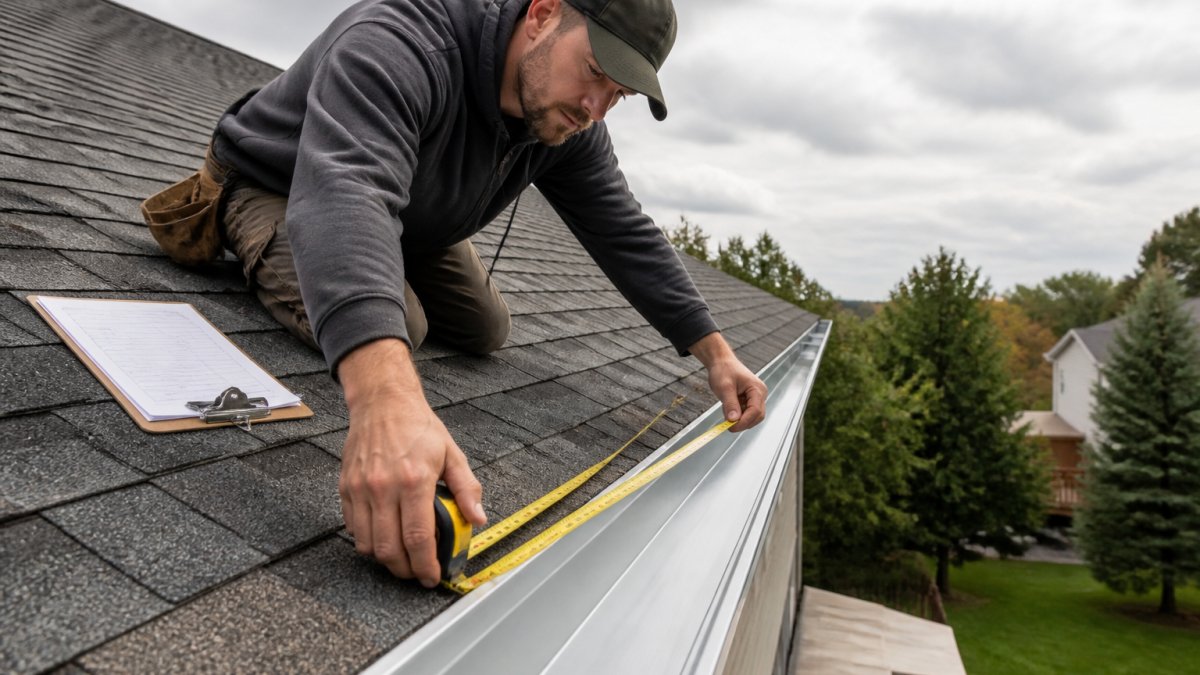
Take the total bid, subtract the material allowance the contractor lists, and divide what is left by the linear footage. That gives you an implied labor-and-hardware rate per foot. Compare that number across three bids on the same house and you will usually find one outlier, either far below the pack (something is excluded) or far above it (something is padded).
| Cost Factor | What It Covers | Typical Impact |
|---|---|---|
| Linear footage | Total gutter run | Primary driver of total cost |
| Material | Aluminum, steel, copper, vinyl | Low to high range |
| Labor | Removal, fabrication, hanging | Rises with stories and access |
| Downspouts | Count and configuration | Added per run |
| Gutter guards | Leaf screens and covers | Optional add-on |
What Moves the Rate Up or Down
Four variables do most of the work:
- Stories. A second story adds ladder time, fall-protection setup, and often a second crew member on the ground.
- Roof pitch and complexity. Steep pitches and multiple roof planes mean more cuts, more corners, and more hangers.
- Run length. Longer runs lower the per-foot rate slightly, because setup and mobilization are spread across more feet.
- Old-system condition. Rotted fascia or failing hangers turn a hang job into a carpentry job, and that shows up in labor.
If a quote is high, ask which of those four is driving it; if it is low, ask which one the contractor is assuming away.
Using a Gutter Replacement Cost Calculator for Your Project
A gutter replacement cost calculator works best when you feed it accurate inputs, not guesses. Measure your roofline, count your downspouts, and note how many stories the crew will climb. Enter those numbers and the tool returns an estimate you can take to three contractors. The calculator is a starting point, not a verdict, use it to spot outliers: if one bid is far below the rest, something is missing.
Gutter Cost for a 2,000-Square-Foot House: A Practical Example
Gutter cost for a 2,000-square-foot house typically falls in the middle of the market, because a home that size usually needs roughly 150 to 200 linear feet of gutter. That footage drives everything else.
Most estimator tools stop there and hand you a range, not enough to plan a project or judge a bid. Below is the methodology a transparent estimate should use, plus two worked examples on the same 2,000-square-foot footprint.
The Assumptions Behind Every Estimate
Before any number means anything, the estimator has to state its assumptions. A credible estimate for a 2,000-square-foot home should disclose:
- Linear footage, derived from roofline perimeter, not floor area. A 2,000-square-foot home commonly lands between 150 and 200 linear feet depending on shape.
- Stories, one story keeps labor at the base rate; two stories adds access time and fall-protection setup.
- Roof pitch, walkable pitches are faster to work; steep pitches slow the crew and raise labor.
If a quote does not state those seven items, it is not an estimate, it is a guess with a signature line.
Worked Example A: Single-Story Ranch, Seamless Aluminum
Assume 180 linear feet, one story, walkable pitch, four downspouts, old gutters removed and hauled away. A transparent estimate breaks into line items:
| Line Item | Basis |
|---|---|
| Seamless aluminum gutter | 180 linear feet at the material-and-fabrication rate |
| Hangers and hardware | Allowance based on rafter spacing |
| Downspouts | 4 runs, including elbows and extensions |
| Removal and disposal | Old system, by the linear foot |
| Labor | One story, walkable pitch, clear access |
| Sealant and touch-up | Flat allowance |
Because the roofline is simple and access is clean, this version sits near the bottom of the market range for a 2,000-square-foot home. The per-foot rate is lower not because the material is cheaper, but because labor is efficient.
Worked Example B: Two-Story Home, Same Footprint
Same 2,000 square feet, but split across two stories with dormers and multiple roof planes. Linear footage rises to about 200 feet, downspouts rise to six, and access is no longer a ladder-and-a-day job.
| Line Item | What Changed |
|---|---|
| Seamless aluminum gutter | More footage, more corners and miters |
| Hangers and hardware | More runs, more fastening points |
| Downspouts | 6 runs instead of 4 |
| Removal and disposal | More old material to haul |
| Labor | Two stories, steeper pitch, fall protection |
| Access equipment | Possible lift or scaffolding allowance |
Same square footage, same material, materially higher total. That gap is the point of an itemized estimate: you are paying for geometry and access, not for metal.
How to Use These Examples on Your Own House
- Measure your roofline perimeter, not your floor plan.
- Count downspouts and note where they discharge.
- Note stories, pitch, and anything blocking ladder placement.
- Decide whether removal and disposal are in or out.
- Hand those five answers to three contractors and require the same line items from each.
When every bid uses the same line items, the comparison is finally honest. When they do not, the cheapest number usually hides the most assumptions.
Gutter Guard Installation Cost and Long-Term Value
Gutter guard installation cost is an add-on, not a replacement for gutters, and it pays back over years rather than months. Guards keep debris out so water keeps flowing, which matters in a climate that swings between heavy rain and dry spells. The value shows up in fewer cleanouts and less risk of overflow damage to your foundation and fascia.
Repair or Replace? Making the Right Call for Your Gutters
Repair makes sense when the damage is isolated; replacement makes sense when the system is failing in multiple places. Leaking seams, a few loose hangers, or one storm-damaged section are repair jobs. Sagging that runs the length of the house, rust through the material, or water pooling at the foundation point to replacement. The honest answer depends on age and how widespread the problems are.
- Seams leaking in one or two spots: repair
- Gutters pulling away along an entire run: replace
- Rust or cracks through the metal: replace
How to Validate a Contractor Quote and Avoid Overpaying
A fair quote is itemized, written, and specific about what is included. Confirm the slope will move water toward the downspouts, not just hang level, and that the crew will clean up. Hung Right Seamless Gutters has built 25 years of work on fair, transparent pricing without corporate markups, and we fabricate seamless gutters on site so they fit your home exactly.
Conclusion: Getting an Accurate Gutter Cost Estimate
The hardest part of any gutter project is trusting the number before the work starts. A good estimator gets you close, and an itemized quote gets you the rest of the way. If you want a straight answer instead of a sales pitch, Hung Right Seamless Gutters offers custom on-site fabrication, specialized leaf guards, and honest pricing with no corporate markup.
Frequently Asked Questions
How much does it cost to put gutters on a 2,000-square-foot house?
A 2,000-square-foot home typically needs 150 to 200 linear feet of gutter, depending on roofline complexity. Material and labor costs vary by region, gutter type, and downspout count. For a precise figure, use a gutter cost for a 2,000-square-foot house calculator or request a free evaluation from a local installer who can measure your specific roofline and account for stories, roof pitch, and accessibility.
What is the average cost of installing gutters per linear foot?
Gutter installation cost per linear foot depends on material, profile, and labor. Aluminum and vinyl are typically on the lower end, while steel and copper cost more. Labor and installation fees add to the total, and factors like roof height, accessibility, and removal of old gutters affect the final per-foot rate. Always ask for an itemized quote that separates material, labor, and disposal.
Are seamless gutters more expensive than sectional gutters?
Seamless gutters usually cost more upfront than sectional gutters from a big box store. The trade-off is fewer leak points, a cleaner look, and longer lifespan. Seamless gutters are fabricated on-site to fit your exact roofline, which reduces the chance of sagging and seam separation. For homeowners dealing with recurring leaks or foundation moisture, the long-term savings often justify the higher initial price.
How much does gutter guard installation add to the total cost?
Gutter guard installation cost varies by guard type, roof pitch, and total gutter length. Guards can add a meaningful percentage to your overall project, but they reduce how often you need to clean your gutters. In areas with heavy tree cover or pine needles, guards often pay for themselves by preventing clogs that lead to water damage and costly repairs.
How do you estimate the linear feet of gutters a house needs?
Measure the perimeter of your roofline where gutters will attach, then add the length of any valleys or additional runs. A typical single-family home uses 150 to 200 linear feet. Roof complexity, number of stories, and downspout placement all affect the total. A gutter replacement cost calculator can give you a rough number, but an on-site measurement is the only way to get an accurate figure.