 how-to
How to Clean Clogged Downspouts: A Step-by-Step Guide
Table of Contents
- Signs of a Clogged Downspout You Should Never Ignore
- Downspout Cleaning Tools You Actually Need
- Step-by-Step: How to Clean Clogged Downspouts
- How to Unclog an Underground Downspout
- How to Prevent Downspout Clogs Before They Start
- When to Stop and Call a Professional
- Frequently Asked Questions
Last Updated: October 5, 2026
Signs of a Clogged Downspout You Should Never Ignore
Water pouring over the edge of your gutters during a rainstorm is the clearest sign of clogged downspouts. At Hung Right Seamless Gutters, we've seen this problem undo years of good drainage work in a single season.
A clogged downspout is a downspout that has trapped enough leaves, roof grit, or debris to block the flow of rainwater. The blockage usually builds at the elbows and the outlet, where the pipe narrows and bends.
Water Overflow and Backed-Up Gutters
Watch your gutters during the next hard rain. If water spills over the front edge instead of running to the downspout, you have a blockage somewhere in the system. Sagging gutters that pull away from the fascia are another clue. The trapped water gets heavy, and that weight pulls the whole run down.
Foundation and Landscape Clues
Check the ground where your downspout empties. Water pooling near the foundation, soil washed away from the base of the house, or a soggy patch that never dries out all point to a clog. Over time, that backed-up water can crack a slab or seep into a basement. Catching it early saves you from repairs that cost far more than a cleaning.
Downspout Cleaning Tools You Actually Need
The right downspout cleaning tools make the job quick and safe. You don't need a truck full of equipment, just a handful of items most homeowners already own.
- Sturdy extension ladder that reaches the gutter line with room to spare
- Work gloves to protect your hands from sharp metal and grime
- Garden hose with a spray nozzle for flushing
Safety Gear and Ladder Setup
Safety comes before anything else. Set the ladder on firm, level ground, never on soft soil or mulch. Keep the base about one foot out from the wall for every four feet of height. Ask someone to hold the ladder while you climb, and never lean out past the rails. If your gutters sit high or your roof is steep, that's a job for a professional, not a weekend climb.
Step-by-Step: How to Clean Clogged Downspouts
Cleaning clogged downspouts takes about 30 to 45 minutes for a typical home. Work from the top down, and let gravity do most of the work for you.

Step 1: Locate the Blockage
Tap along the downspout with your hand. A hollow ring means clear pipe. A dull, solid thud means debris is packed inside. Most clogs sit at the top elbow or the bottom outlet, so start your check there.
Step 2: Remove Debris and Flush with a Garden Hose
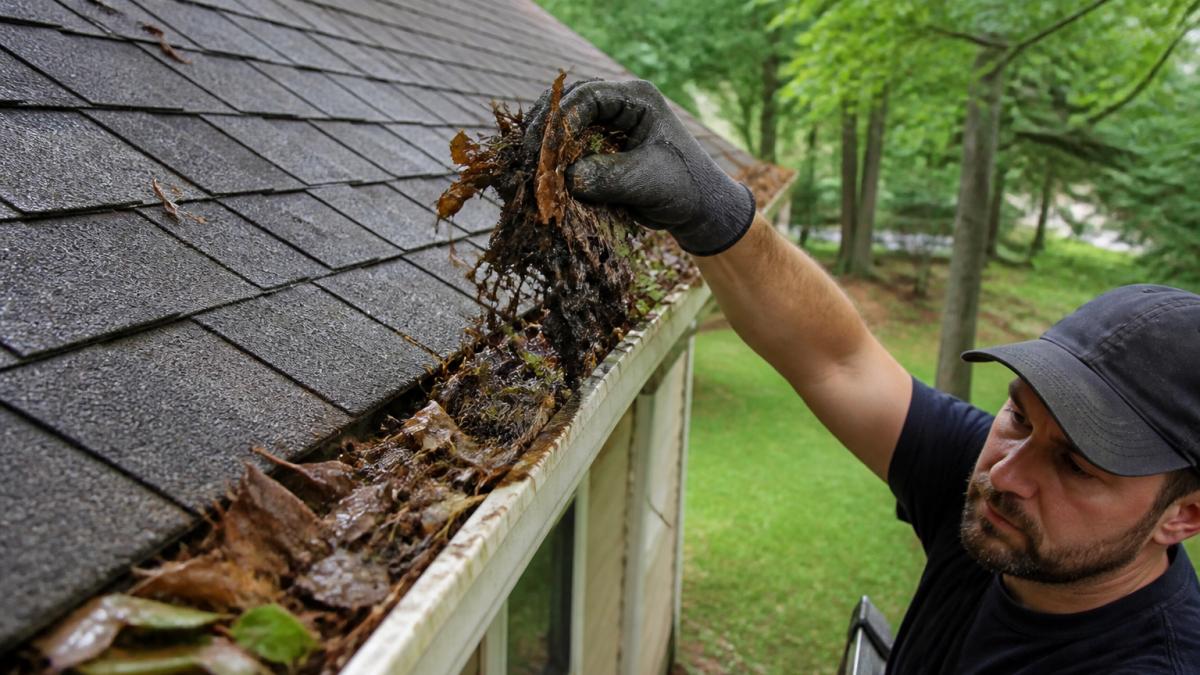
Pull out leaves and debris by hand from the top opening. Then run a garden hose down the spout. Low hose pressure is safer than a hard blast, which can push a clog tighter or split an old joint. If water backs up and spills out the top, the clog is still there.
Step 3: Use a Plumber's Snake for Dense Clogs
For a dense clog, feed a plumber's snake down from the top. Crank it through the blockage, then flush again with the hose. If the snake won't pass, work from the bottom up. A drain snake reaches clogs that water alone can't move.
| Step | Tool | Time | What Success Looks Like |
|---|---|---|---|
| Locate blockage | Hands | 5 min | Dull thud marks the clog |
| Remove and flush | Hose | 15 min | Water flows freely out the bottom |
| Clear dense clog | Plumber's snake | 15 min | Snake passes through, flow returns |
How to Unclog an Underground Downspout
An underground clog behaves differently from an above-ground one, and the fastest way to waste an afternoon is to start snaking the wrong section. Before you touch a tool, isolate where the water is actually stopping.
Run the Three-Point Diagnostic First
Work through these checks in order. Each one narrows the blockage to a smaller stretch of pipe.
- Watch the downspout during a hard rain. If water pours out the top of the downspout instead of draining away, the blockage is at or below the point where the downspout meets the buried line, not in the gutter.
- Disconnect the downspout from the underground drain. Many installations use a slip joint, a screw-on cap, or a flexible connector at this transition. Run a garden hose straight onto the ground. If water flows freely, the downspout itself is clear and the problem is in the buried pipe.
- Open the line at the next access point. Look for a Y connector, a pop-up emitter, a cleanout cap, or a splash block at the discharge end. If you find standing water in the line after a rain, the pipe is blocked between that point and the downspout.
If the downspout drains fine when disconnected but the buried line stays full, you have confirmed an underground clog. If water backs up even with the downspout disconnected, the clog is in the downspout itself and you should return to the above-ground steps.
Match the Clearing Method to the Clog
Once you know the clog is underground, the method depends on what is causing it and how the line is built.
- Hand auger or drain snake (manual): Best for soft clogs made of leaves, roof grit, or silt. Feed the auger from the cleanout or the open end of the pipe and crank it through the blockage. Manual augers typically reach 15 to 25 feet, so they work well for short runs but not long ones.
- Hose with a high-pressure nozzle: Useful for flushing loosened debris after augering. A standard garden hose alone rarely clears a packed underground clog, and too much pressure can blow apart older clay or thin-wall PVC joints.
- Jetting or professional augering: For long runs, root intrusion, or repeated clogs, a powered drain auger or hydro-jetting equipment is the practical option. These are typically rented or handled by a drain-cleaning professional.
What to Check After the Line Is Clear
Run water through the full system and watch the discharge end. You want steady, unrestricted flow with no backup at the downspout connection. Then check for:
- Water pooling near the foundation instead of discharging away from the house
- A pop-up emitter that stays closed or barely opens
- Wet ground along the buried line, which can signal a cracked or separated pipe
If the line drains but the ground stays soggy along its path, the pipe is likely damaged below the surface. That is a job for a professional with a camera or locating equipment, not a homeowner with a hand auger.
How to Prevent Downspout Clogs Before They Start
Prevention advice is everywhere, but most of it ignores the fact that the right fix depends on your trees, your roof, and whether your downspouts run underground. Use the comparison below to pick the measures that actually fit your situation.
Prevention Options Compared by Situation
| Situation | Best First Move | Why It Fits | Limits to Know |
|---|---|---|---|
| Pine needles or small seed pods | Micro-mesh gutter screen | Blocks the fine debris that slips through standard guards | Can shed heavy rain if not installed with correct pitch |
| Large leaves from oaks or maples | Snap-in or hinged leaf guard | Handles big debris and can be lifted for cleaning | Still needs periodic clearing at the downspout outlet |
| Roof grit from asphalt shingles | Gutter screen plus downspout strainer | Catches granules before they pack into elbows | Strainers need rinsing after heavy storms |
| Downspouts that run underground | Pop-up emitter or discharge grate at the outlet | Lets you see and clear the discharge point | Does not stop debris that enters at the top |
| Long buried runs under walkways | Cleanout access at the transition | Gives you a place to snake or flush without digging | Requires installation if none exists |
| Heavy tree cover on all sides | Twice-yearly cleaning plus guards | Guards reduce load but do not eliminate it | Cleaning is still required, just less often |
Seasonal Maintenance That Actually Prevents Clogs
Timing matters more than frequency. Two well-timed cleanings beat four random ones.
- Late spring: Clear anything that collected over winter and spring storms, including grit and small twigs.
- After fall leaf drop: This is the single most important cleaning of the year. Leaves that sit in a downspout elbow through winter compact into a solid plug.
- After any major storm: Check the discharge point and the downspout outlet. A single storm can push a season's worth of debris into the system.
Simple Habits That Extend the Life of Your System
- Trim branches back from the roofline so they stop dropping debris directly onto the roof.
- Check that downspouts discharge at least 4 to 6 feet from the foundation, or into a buried line that carries water well away from the house.
- Test flow with a garden hose each season. Run water through the downspout and watch the discharge end. Slow flow is an early warning.
When Prevention Alone Is Not Enough
Guards and screens reduce how often you clean, but they do not replace maintenance. A system with guards still needs an annual check at the downspout outlet and the discharge point. If your home sits under heavy tree cover, or your downspouts run into long buried lines, plan on a professional inspection every few years to confirm the underground portion is still intact.
When to Stop and Call a Professional
Some jobs aren't worth the risk. Stop and call a pro if any of these apply:
- The clog sits deep in a buried line or under a walkway
- Your gutters sag, leak at the seams, or pull loose from the house
- The roofline is steep or higher than a standard ladder can safely reach
A pro can also spot damage you'd miss from the ground, like a crushed underground pipe or a joint that's failed. Fixing a small problem now prevents a flooded foundation later.
Clogged downspouts are a small problem that turns into an expensive one fast. If your gutters overflow, sag, or pool water near the foundation, it's time to act. Hung Right Seamless Gutters has spent over 25 years helping homeowners protect their properties with custom seamless gutters and leaf guards built for local weather.
Frequently Asked Questions
What should you not use to clean gutters?
Avoid using a pressure washer on full blast, as high pressure can damage gutter seams and push water behind the fascia board. Never use a metal rake or sharp tool that can scratch the gutter surface. Don't stand on the top rung of a ladder or lean out too far. Also skip chemical drain cleaners, which can harm plants and corrode metal downspouts over time. Stick with a garden hose, a plumber's snake, and a gutter scoop for safe, effective cleaning.
How do I know if my underground downspout is clogged?
Watch the downspout during a rainstorm or run a hose into it. If water backs up and overflows at the top, or you see water pooling near the foundation instead of draining away, the underground section is likely blocked. You can also check the drain outlet. If no water comes out while you're running a hose into the downspout, the buried pipe has a clog or a collapse. A plumber's snake or a hose with moderate pressure can often clear it.
Can you use a garden hose to unclog a downspout?
Yes, a garden hose works well for most clogs. Attach a spray nozzle and feed the hose into the downspout from the top. Turn the water on at moderate pressure. The force of the water pushes leaves and debris through the pipe. If the water backs up, the clog is dense. Switch to a plumber's snake to break it loose, then flush again. For underground sections, feed the hose from the bottom up or use a drain auger.
When should you call a professional to clear a clogged downspout?
Call a professional if the clog won't budge after trying a hose and a snake, if you see standing water near your foundation, or if the downspout is damaged or disconnected. Also call if you're uncomfortable on a ladder or if the clog is deep in an underground drain you can't reach. A pro can inspect the full system, clear stubborn blockages, and check for sagging or leaks that need repair.