 how-to
7 Things to Know About Residential Gutter Installation Services
Last Updated: October 25, 2026
Quick Summary
Residential gutter installation services cover the full removal and replacement of a home's rainwater drainage system, from tearing off old gutters to testing water flow at the downspouts. A real gutter installation involves sizing, pitch, and drainage decisions that determine whether your foundation stays dry. Most homes are done in one to two days.
- Seamless runs are formed on-site to the exact length of each roofline section, so the only joints are at corners and downspout outlets.
- Aluminum is the most common residential choice because it resists rust, weighs little, and forms cleanly on a seamless machine.
- Gutter installation cost is driven by linear footage, material, stories, and downspout count, not a flat per-house rate.
- A common target is about 1/4 inch of drop per 10 feet of run, with hangers every 24 inches on center.
- Repair makes sense when damage is isolated to a joint, a hanger, or one downspout; replacement fits widespread leaks or sagging.
Table of Contents
- What Residential Gutter Installation Services Actually Include
- Seamless Gutter Installation: Why One Continuous Run Beats Sections
- Gutter Materials: Aluminum, Steel, and What Fits Your Roofline
- How Gutter Installation Cost Adds Up on a Real House
- Reading a Gutter Installation Quote Without Getting Burned
- Sizing, Slope, and Downspout Placement: The Details That Stop Water Damage
- Repair or Replace? How to Decide Before You Sign Anything
- Schedule a Free Evaluation With Hung Right Seamless Gutters
- Frequently Asked Questions
What Residential Gutter Installation Services Actually Include
Residential gutter installation services cover the full removal and replacement of a home's rainwater drainage system, from tearing off old gutters to testing water flow at the downspouts.
A real installation is not just "hang some metal on the fascia." It's a sequence of decisions about sizing, pitch, and drainage that determine whether your foundation stays dry for the next two decades.
From tear-off to final water test
Here's the order of operations on a typical job:
- Inspection and measurement. We check the roofline, fascia condition, and existing downspout locations, then measure total run length to size the system.
- Tear-off. Old gutters, hangers, and fasteners come down. Rotted fascia gets flagged before anything new goes up.
- Fabrication. Seamless runs are formed on-site to the exact length of each roofline section.
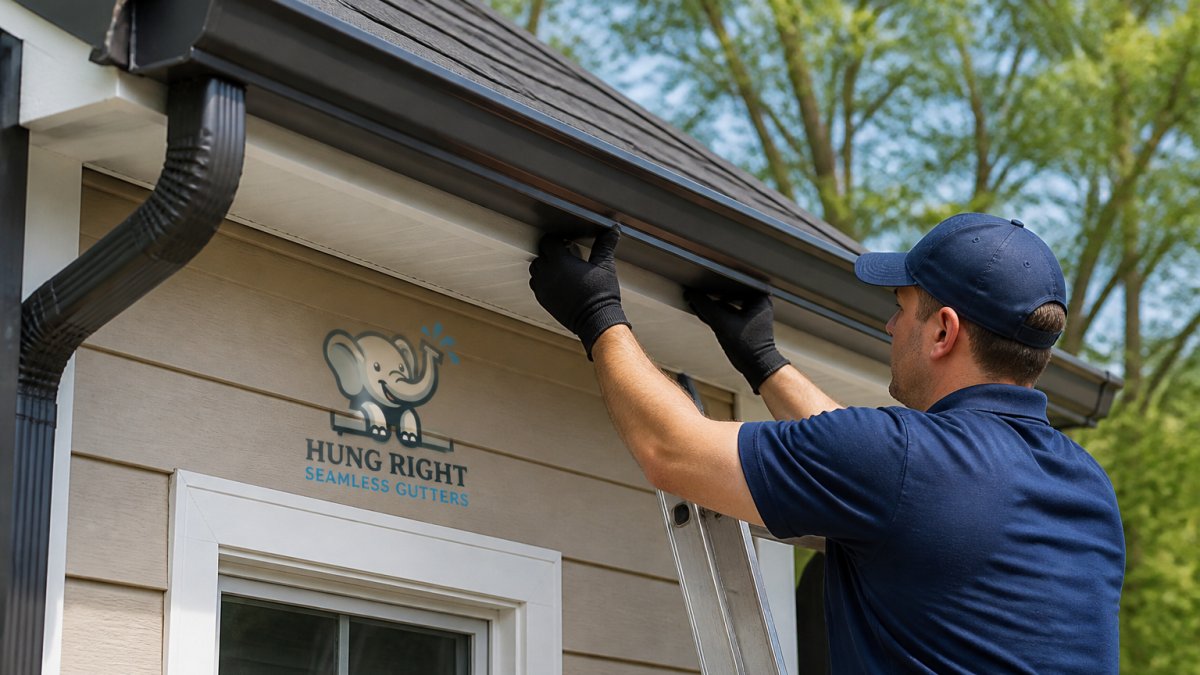
- Mounting. Hangers are spaced to support the run, and the gutter is pitched toward the downspouts.
- Downspout connection and discharge. Water gets routed away from the foundation, not dumped at the wall.
- Water test. We run water through the system and watch for pooling, leaks, and low spots.
Most homes are done in one to two days. The water test at the end matters more than people realize. A gutter that looks perfect can still hold standing water if the pitch is off by a fraction.
Seamless Gutter Installation: Why One Continuous Run Beats Sections
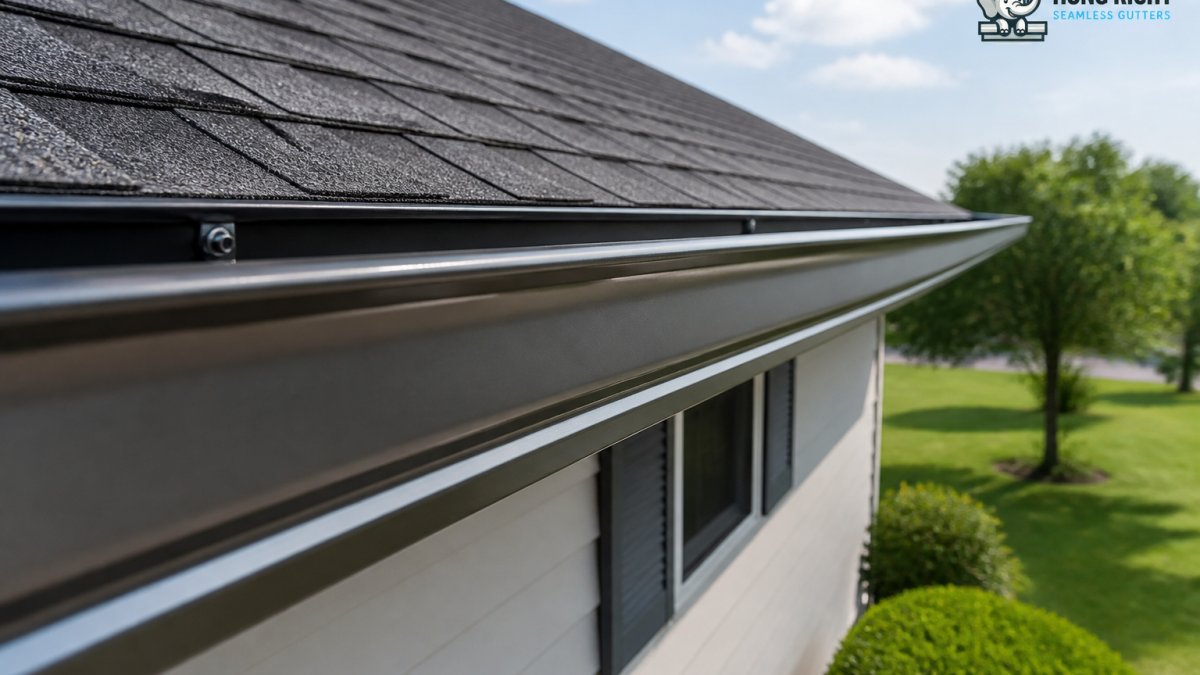
Seamless gutter installation forms each gutter run as a single piece on-site, eliminating the joints where sectional gutters leak. That's the whole argument in one sentence: fewer seams means fewer failure points.
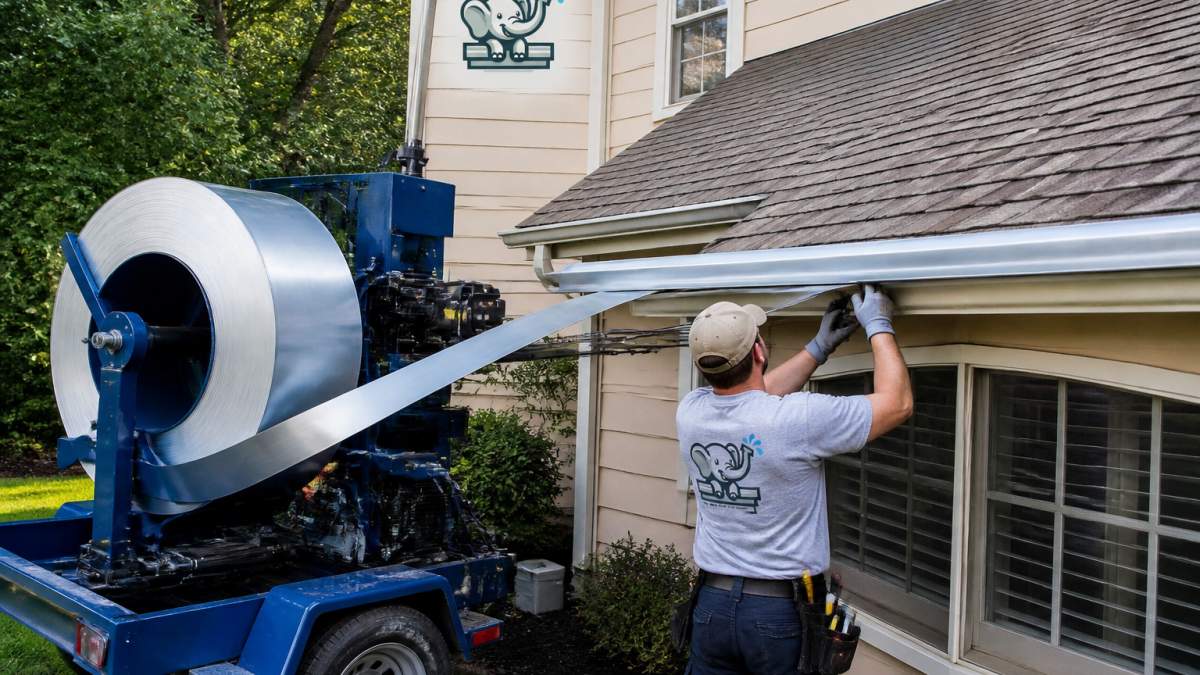
Sectional gutters from a home improvement store come in fixed lengths that join every few feet. Each joint gets a sealant or gasket that eventually dries, cracks, or pulls apart.
Seamless runs are cut to the exact length of your roofline, so the only joints are at corners and downspout outlets. For a deeper, local walkthrough of the process, read our Seamless Gutter Installation in Tyler: A Complete Guide.
Gutter Materials: Aluminum, Steel, and What Fits Your Roofline
Aluminum gutters are the most common choice for residential gutters because they resist rust, weigh little, and form cleanly on a seamless machine.
What most guides miss is that material choice should follow your roofline, not the other way around.
A few practical notes:
- Aluminum suits most homes and is the easiest to fabricate on-site in custom lengths.
- Steel makes sense where debris loads are heavy or runs are long.
- Color and finish matter less for performance than people think, but a factory finish outlasts field-painted metal.
The right answer depends on your roof pitch, tree cover, and how the water needs to travel once it leaves the gutter.
How Gutter Installation Cost Adds Up on a Real House
Gutter installation cost is driven by linear footage, material, stories, and the number of downspouts, not by a flat per-house rate. We don't publish flat pricing because two houses on the same street can need very different systems. What we can do is show you how the number is built, so you can read a quote and know which line items are real and which are padding.
The line items that move the number
- Total linear feet of gutter required. This is the base unit every installer prices against. Measure the roofline runs that actually collect water, not the footprint of the house.
- Number of stories, which affects labor and equipment. A second story means ladders, staging, and slower work per foot.
- Material choice, since steel costs more than aluminum per foot and per hanger.
How the math actually works
Most installers build a price in three layers: material cost per linear foot, labor cost per linear foot (adjusted for height and access), and a job-level charge for tear-off, disposal, and any carpentry. A common pattern is that the per-foot number homeowners compare between bids is the least reliable part of the quote, because one bid may fold tear-off into the per-foot rate and another lists it separately.
A practical way to compare bids is to ask each installer to break the quote into four buckets: gutters and hangers, downspouts, tear-off and disposal, and add-ons such as guards or fascia repair. When every bid uses the same buckets, the real differences show up. A bid that is dramatically lower almost always has an empty bucket somewhere.
What tends to surprise homeowners
- Height premiums. Two-story and steep-pitch rooflines cost more per foot because of access and safety equipment, not because the gutter is different.
- Corner count. Every inside and outside corner is a fabricated piece and a potential leak point, so complex rooflines carry more labor.
- Disposal. Hauling away old gutters and fasteners is a real cost that some quotes omit and then add later.
The honest version: get a written quote based on your specific roofline, insist on the four-bucket breakdown, and be suspicious of anyone who quotes a number before measuring.
Reading a Gutter Installation Quote Without Getting Burned
A gutter installation quote should list linear footage, material, hanger type and spacing, downspout count, and whether tear-off and disposal are included.
The thing nobody tells you about quotes is that the cheap ones usually leave something out. Common omissions:
- Old gutter removal and haul-away
- Fascia repair if damage is found
- Downspout extensions or splash blocks
Ask directly whether the quote covers tear-off, disposal, and any fascia work. Ask what happens if rot is found once the old system comes down.
Also confirm the warranty terms in writing, and ask whether the installer is insured.
Sizing, Slope, and Downspout Placement: The Details That Stop Water Damage
Correct gutter sizing, a consistent slope toward downspouts, and well-placed discharge points are what actually prevent water damage. Get any of the three wrong and the system fails no matter how good the material is. This is the part of the job most homeowners never see and most cheap bids skip.
Sizing: match the gutter to the roof area draining into it
Gutter size is set by two inputs: the roof area that drains to a given run, and the rainfall intensity the system has to handle. A common residential rule of thumb is that a 5-inch K-style gutter handles roughly 5,500 square feet of roof area and a 6-inch gutter handles roughly 7,900 square feet, adjusted downward for steep pitches and heavy tree cover. Those are starting points, not code, and a run that collects water from a large upper roof plus a lower roof needs to be sized for the combined area.
An undersized gutter overflows in a heavy storm, sending water down the siding and pooling at the foundation. For guidance on picking the right size for your home, see Choosing The Right Gutter Size For Texas Homes. The tell is a waterfall at the gutter edge during a downpour while the downspouts run clear. If that is happening, the problem is capacity, not clogging.
Slope: steady, not steep
Gutters need a slight pitch toward the downspout so water moves without standing. A common target is about 1/4 inch of drop per 10 feet of run.
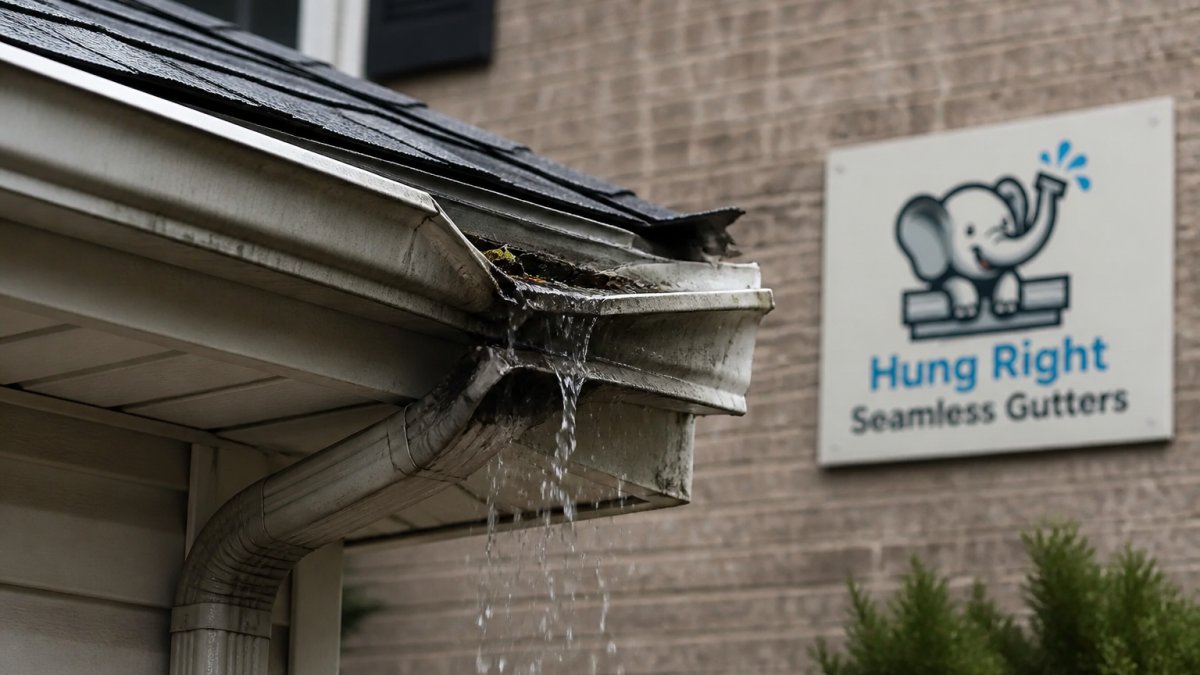
The failure mode to watch for is a run that was installed level and then sagged. Standing water in the middle of a run, visible as a dark line or debris ring, means the hangers are spaced too far apart or the pitch was never set.
Downspout placement and discharge
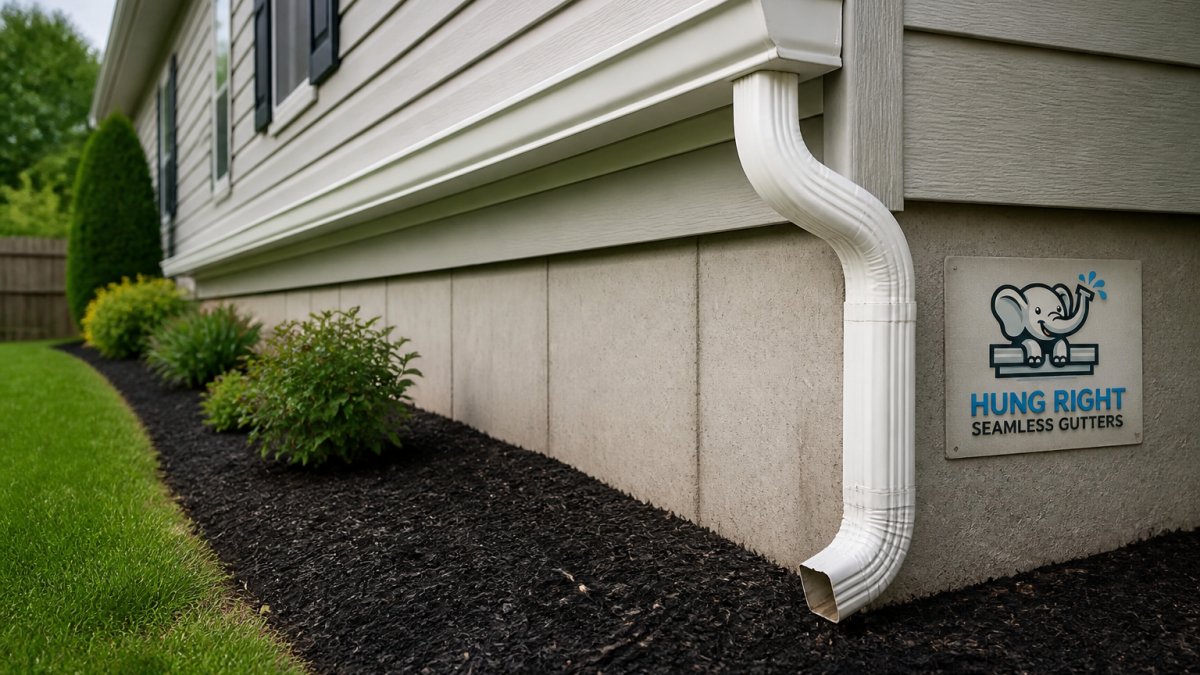
Downspouts need to be placed so no single run carries too much water, and discharge should direct water away from the foundation rather than dumping it at the wall.
Discharge is where most systems quietly fail. A splash block at the wall is not enough. Water should be carried at least 4 to 6 feet from the foundation, and farther on sloped lots, ideally onto graded ground that carries it away from the house.
How the three interact
Sizing, slope, and discharge are a system. A correctly sized gutter with a flat run pools water. A well-pitched run with too few downspouts overflows at the outlet. A perfect gutter and downspout layout that dumps at the foundation just moves the water problem to the basement.
Here are the key sizing, slope, and downspout figures the article cites as starting points.
| Item | Value | Note |
|---|---|---|
| 5-inch K-style gutter | Roughly 5,500 square feet of roof area | Adjust downward for steep pitches and heavy tree cover |
| 6-inch gutter | Roughly 7,900 square feet of roof area | Starting point, not code |
| Gutter slope | About 1/4 inch drop per 10 feet | Steeper looks bad; flatter leaves pools |
| Hanger spacing | Every 24 inches on center | Closer in snow country or heavy debris loads |
| Downspout count | One per roughly 30 to 40 feet of run | Outlet at each end of long runs and inside corners |
| Discharge distance | At least 4 to 6 feet from the foundation | Farther on sloped lots |
Repair or Replace? How to Decide Before You Sign Anything
Repair makes sense when the damage is isolated to a joint, a hanger, or one downspout. Replacement is the better call when seams are leaking in multiple places, the system is sagging along long runs, or the gutters are undersized for the roof.
Ask yourself these questions:
- Are leaks concentrated in one spot, or spread across the system?
- Is the sagging limited to one section or showing up everywhere?
- Has the system already been patched more than once?
If you're answering "everywhere" and "yes" to those, patching is throwing money at a system that's already done. We'll tell you honestly when a repair will do the job.
Schedule a Free Evaluation With Hung Right Seamless Gutters
The fastest way to know what your home actually needs is a free evaluation. We inspect the roofline, check the existing system, and give you a straight answer on repair versus replacement, with no pressure and no corporate markup baked into the number.
As a family-owned team with 25 years of hands-on experience, we fabricate custom seamless gutters on-site, install leaf guards built for local weather, and leave your property clean when the job is done. You can schedule a free evaluation with our team and get a written quote based on your actual roofline.
Frequently Asked Questions
How long does residential gutter installation take?
Most single-family homes are finished in one to two days. Seamless gutter installation is faster than sectional because the runs are formed on site and hung in long pieces, so there are fewer joints to seal. Larger homes, two-story rooflines, or jobs that include tear-off of old gutters and new leaf guards can push into a second day. Ask your installer for a timeline in writing so you can plan around the crew being on your property.
Are seamless gutters worth the extra cost over store-bought sections?
Seamless gutters cost more up front than boxed sectional pieces, but they have far fewer seams, and seams are where most leaks and sagging start. A continuous run fabricated on site also fits your roofline exactly, so it handles heavy rain without overflowing at joints. Ask for a gutter installation quote that lists both options side by side.
What should I look for when hiring a gutter installer?
Check for a local business with a real address, proof of insurance, and a warranty that covers both labor and materials. Ask how long they have worked in your area, whether they fabricate seamless gutters on site, and who handles storm damage calls. Get a written gutter installation quote with itemized materials, downspout counts, and cleanup included. A crew that answers questions about slope and drainage clearly is usually the one that shows up and stands behind the work.
How do I know if my gutters need repair or full replacement?
Localized leaks at seams, a loose hanger, or one bent section can often be repaired. Replace the system when gutters sag along long runs, pull away from the fascia, leak at multiple points, or when the fascia behind them is soft or stained. If your foundation is showing water damage, have the slope and downspout placement checked first. A free evaluation can tell you whether a targeted repair solves it or whether a replacement system is the cheaper path over the next few years.
Your gutters only get one chance to be installed right, and the details that matter most, slope, sizing, and downspout placement, are invisible once the job is finished. Get those right and the system quietly does its job for decades. Get them wrong and you'll be calling someone again in a few years. Get started with Hung Right Seamless Gutters and protect your home with a drainage system built to last.